

There was an eight-team, September 23-28, 1955 Global World Series (GWS), hosted by Milwaukee’s County Stadium. Legwork was provided by A.B. «Happy Chandler,» Commissioner of Baseball and President of the International Baseball Congress (IBC). Chandler felt that a more centralized location was necessary, namely, an American city. He was aware that someone had to underwrite the cost and be willing to absorb possible financial loss. Fortunately, details on the 1955 GWS exist thanks to Bob Buege’s Society for American Baseball Research (SABR) article at: https://sabr.org/journal/article/global-world-series-1955-57/. Team rosters were made available by Jorge Colón Delgado’s extensive research.
Why Was Milwaukee Chosen?
Dick Falk, the Milwaukee GWS coordinator, was appointed in 1939 as the Wisconsin Commissioner of the National Baseball Congress (NBC) by Raymond Dumont, who, coincidentally, helped set up the 1939 and 1940 NBC World Series between the Puerto Rico (PR) Semi-Pro Champion Guayama Witches and two NBC champions (Duncan Cementers and Enid Refiners), both from Oklahoma. Those events were held at San Juan’s Sixto Escobar Stadium, mid-to-late September. Falk was a hard worker, a diehard baseball fan, a civic leader, a World War II Marine Corps officer, and assistant to the president of the Falk Corporation, a manufacturer of industrial gears in Milwaukee since 1895. The Milwaukee Braves were on the road the last week of the 1955 season.
Falk rounded up more than 100 local businesses as sponsors to stage a first-rate event. Every team’s delegation was given an elaborate welcome upon arrival at Mitchell Airport. The teams passed beneath a flower-covered arch and onto a red carpet as they stepped down from the airplane. Each team received this royal treatment, except the PR group, which arrived almost 5 hours early and found no one to greet them. That night, a one-hour parade through downtown Milwaukee kicked off the festivities with marching bands, drum and bugle corps, giant inflated balloons, and colorful floats.
The eight teams participating in the inaugural Global World Series spanned the globe, representing North America, South America, Asia, and Europe, Central America, and island nations in the Pacific and Caribbean. They spoke a variety of languages. Colombians deplaned with only one English-speaking person, who was sick. The Japanese interpreter was asked how his country’s players would argue with the umpires without speaking English. The answer was simple: «We never argue with the umpire.»
The 1955 GWS Rosters
Team rosters for Canada, Colombia, Hawaii, Japan, Mexico, Puerto Rico (PR), Spain, and the USA are included, with background:
Canada—#1 Len Breckner (RF), #2 Charles Bogan (P), #3 Les Dean (P), #4 Joe Kretschmar (SS), #5 Cliff Pemberton (3B), #6 Jim Ryan (1B), #7 Benny Griggs (P), #8 Ed Garay (C), #9 Ralph Mabee (MGR), #10 John Ford (IF), #11 Art Stone (2B), #12 Sergio Fabre (P), #14 Jack McLeod (P), #15 Jim Shirley (C), #16 Mario Herrera (CF), #17 John Doucette (P), #18 Don Stewart (LF). These were the Saskatoon Gems, mostly USA collegiate players, not the champion Edmonton Eskimos, who lost their invitation to Milwaukee after refusing to add five reinforcements, as dictated by league rules.
Colombia—#1 Antonio (C), #3 Justo de Avila (IF), #4 Alejandro Manjarres (IF), #5 Pedro Miranda (IF), #6 Humberto Román (IF), #7 Gabriel Nuñez (OF), #8 Carlos Bustos (OF), #9 Humberto Vargas (OF), #10 Vulio López (P), #11 Fernando Correro (P), #12 Celedonio Navarro (P), #14 Francisco López (UT), #15 Enrique Hernández (P), #16 Pedro Pagés (MGR). Pagés was a 41-year-old Cuban OF/1B, who played for the 1947 New York Cubans, winners of the 1947 Negro World Series versus the Cleveland Buckeyes. Pagés also managed Torices de Cartagena to two championships (1953 and 1954) in Colombia’s Pro Baseball League. In 1997, he was inducted into the Cuban Exile Baseball Hall of Fame. Most Colombians played ball in coastal cities such as Barranquilla and Cartagena, or in small towns closer to sea level. Their infielders were collectively good defenders.
Hawaii—#1 Sol Kaulukukui (C), #2 Dick Kitamura (SS), #4 Stan Hashimoto (OF), #5 Tsune Watanabe (2B), #6 Len Kasparovitch (P), #7 James Doole (P), #8 Victor Mori (OF), #9 Larry Kamishima (OF), #10 Ed Vemori (IF), #11 Riki Watanabe (OF), #12 Shin Yogi (3B), #13 Chris Mancao (P), #18 Masa Gunda (1B), #19 Jack Ladra (OF), #20 Majo Uyehara (P). These Honolulu Red Sox were a feisty team and preferred being called Honolulu to Hawaii. They weren’t part of Dumont’s NBC, but brought Duke Kahanamoku, Honolulu’s sheriff, with them. Duke was a two-time Olympic Gold Medalist for Team USA in the 100-meter swimming events at the 1912 and 1920 Games, decades before Hawaii became a State in 1959.
Japan—#1 Naotaka Makino (MGR), #3 Sadayoshi Osawa (P), #5 Osamu Yamamoto (P), #6 Kasuo Fukishima (P), #7 Sadao Kawai (P), #8 Shigekazo Matsumoto (P), #9 Kimiya Nishikawa (P), #10 Masao Matsubara (C), #11 Yoshitomi Taneda (C), #12 Hidekazu Iwanaka (2B), #14 Yutaka Matsumoto (SS), #15 Teruo Ishihara (UT), #16 Shinzo Yamahsita (1B), #17 Masao Hiraide (3B), #18 Soichi Arakawa (RF), #19 Atsushi Otsu (CF), #20 Takashi Tako (LF). County Stadium fans rooted for the Japanese Kanebo All-Stars. They traveled the furthest; their players were of small stature but polite crowd-pleasers. They were contact hitters who put the ball in play.
Mexico—#1 Domingo Rangel (CF)Naotaka Makino (MGR), #2 Agustín Aguinaga (OF-P), #3 Miguel Fernández (2B), # 4 Rafael Pedroza (P), #5 Alfonso Huizar (3B), #6 Juan Galarza (P), #7 Roberto Zazveta (C), #8 Jesús Valenzuela (Coach), #12 Francisco Carrizales (P), #13 Ramiro Caballero (1B), #14 Ernesto Terán (LF), #15 Ramón Brown (P), #16 Roberto Vargas (SS), #17 Rafael López (C), #18 Aaron Flores (RF), #20 José Delfín (P). Refinerías from Mexico were the perennial champions of the Poza Rica League in Central Mexico, not to be confused with Mexico’s Pacific [Winter] League, where Luke Easter homered 20 times in the 80-game season from October 1954 to February 1955. Bobby Avila, from the Poza Rica League, won the 1954 American League batting crown in 1954 (.341 BA) with the 111-43 Cleveland Indians. The author’s research indicated that the Poza Rica and Mexican Pacific [Winter] Leagues held baseball games from Thursday to Sunday.
PR—#11 Santiago Quidgley (P-OF-1B), #12 Dick Seay (Coach), Francisco Carrizales (P), #14 Angel Hernaiz (1B), #18 Luis Recurt (2B), #19 Julio Martínez (Propertyman), #20 William Hill (P), #21 Minski Cartledge (P), #22 Jimmy Jenkins (OF), #26 Ismael Pérez (OF), #27 Ralph Zabala (C), #28 Félix Ortiz (3B), #30 Melvin Duncan (P), #31 Rafael Casanova (C), #34 John Kennedy (SS), #35 Luis R. Olmo (MGR), #36 Kelly Searcy (P), #39 Alfonso Gerard (OF). «Piggy» Gerard was PR’s best hitter, having played 11 PR Winter League (PRWL) seasons, most recently 1954-55, when his Santurce Crabbers (47-25) won the league crown and, in February 10-15, 1955, the Caribbean Series (CS) in Caracas. Left-handed hitting Piggy went 28-for-84, .333 BA, as a Crabbers’ 1954-55 reserve OF, behind Roberto Clemente (LF), Willie Mays (CF), and Bob Thurman (RF). Coincidentally, manager Olmo went 20-for-73 (.274 BA) with the same 1954-55 Crabbers, with two HR and nine RBI.
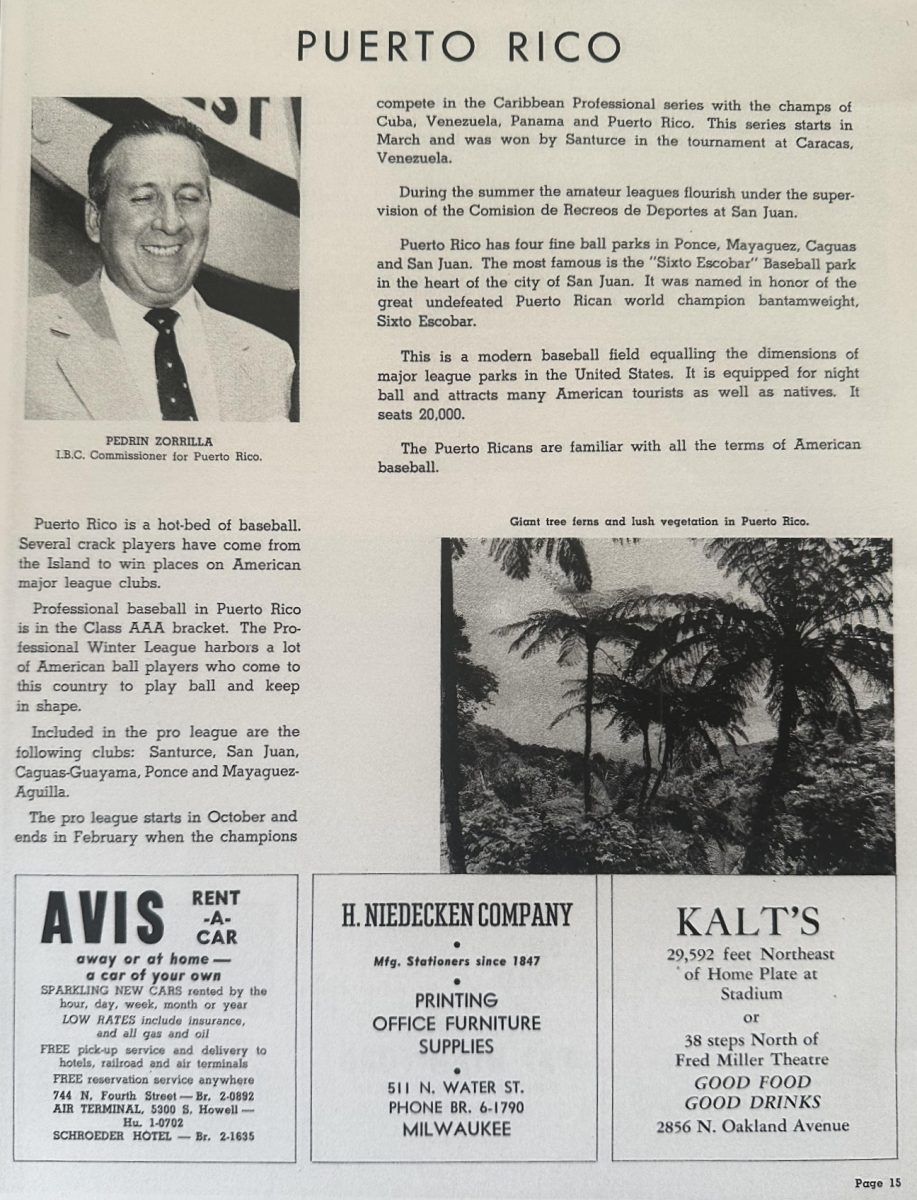
In 1951, Olmo starred for the Class-AAA Milwaukee Brewers, winners of the Junior World Series. He was well-liked by Milwaukee baseball aficionados. PR’s best prospects and players at the time—Rubén Gómez (NYG), Clemente (Pittsburgh), Vic Power (KC A’s), Tite Arroyo (St. Louis Cardinals), Pantalones Santiago (Cleveland Indians), Roberto Vargas (Milwaukee Braves), Carlos Bernier (Pacific Coast League), Canena Márquez (Pacific Coast League), Orlando Cepeda (NYG low minors), José Pagán (NYG low minors), Julio Navarro (NYG low minors), and others—were ineligible/unavailable for Team PR, considered a pre-tournament title threat. Pedrín Zorrilla, PR’s GM, was a Caribbean legend, the first owner in PRWL and Caribbean history to have three CS champions: 1951, 1953, and 1955 Santurce Crabbers.
Spain—#1 Angel Redondo Carrillo (P), #2 Guillermo García Calzadilla (1B), #3 Antonio Redon Banacolacha (C), #4 Francisco Amescua Pérez (CF-P), #6 Juan Casals Masip (SS), #7 Miguel Navarro Pérez (LF), #8 José Rafael Abraham Baez (P), #9 Jacinto Barrio Maldonado (MGR), #10 Joaquín Gallardo Alberdi (P-1B), #11 Antonio Pueyo Gil (P), #12 Pedro A. Seda Bonilla (P), #14 Guillermo Gabriel Buniva (2B), #15 Luis Gómez Pérez (CF), #16 Marcelo Lacalle Rosinach (P), #17 Francisco Abad Ojea (C), #18 Jaime Peralta Ramón (3B), #20 Cecilio Gandul Plaza (Coach). The Spanish National All-Stars had a history of being Europe’s best, but were a weak ballclub. Until recently, they played baseball on soccer fields, with rules adapted to overcome the restrictions of the playing environment.
USA—#11 Minor Scott (3B), #12 Dud Carson (C), #13 Steve Kovach (C), #15 Andy Teter (CF), #16 Jim Morris (P), #17 Delos Smith (P), #18 Mike Werbach (P), #19 Jim Mitchell (2B), #20 Les Layton (2B), #21 Gene Rogers (RF), #22 Loren Packard (1B), #23 John Konek (1B), #24 Ernie Logan (RF), #25 Jim Upchurch (P), #26 Daryl Spencer (SS). The Boeing Bombers from Wichita, Kansas, defeated the Sinton (Texas) Oilers in the 1955 NBC, the 20th anniversary of this national tournament. (Satchel Paige, 1935 Bismarck Churchill’s, was that NBC MVP with a 4-0 W-L mark.) The 1955 Bombers were led by NYG and future San Francisco Giants infielder Daryl Spencer, a Wichita native serving an Army hitch at Fort Sill, Oklahoma. Spencer—MVP of the 1955 NBC—impressed Team PR GM Pedrín Zorrilla, and would play for the 1955-56 Santurce before being traded to Caguas for OF Allie Clark, late that season. Most of the 1955 Bombers lineup worked at Boeing assembling B-47E Stratojets and B-52 Stratofortress bombers. All had minor-league baseball experience.
The Games
Ebbets Field in Brooklyn was considered an alternate site, since Dodgers president Walter O’Malley had already volunteered the use of it for a world tournament. County Stadium prevailed due to its energetic local host role in monitoring and overseeing the tournament and its large/enthusiastic fan base.
The Friday night (September 23) opener matched the Saskatoon Gems and the Japanese Kanebos under a cool autumn sky. Japan scored two runs in the top of the first, but they never scored again off Canada’s Charlie Bogan. Meanwhile, the Canadians scored four times in the bottom of the first, paced by a home run by first baseman Jim Ryan, to give Bogan all the runs he needed. In the fifth inning, the Gems also pulled off a triple play, the first ever in County Stadium. The Japanese club tried everything, including using three different third-base coaches in the eighth inning, but Canada defeated Japan, 5–2.
The next day featured four games. The afternoon’s first contest quickly became the most entertaining of the week. The Milwaukee Journal described it aptly as «a comedy in six and one-half acts.» The Hawaii Red Sox overwhelmed the Spanish team, 23–0, in a game that was not as close as the score suggested. The tournament had a «mercy rule» that terminated any game in which a team was losing by 8 runs or more after 7 innings. Spain’s hitters were porous, but their greatest deficiency was pitching. Starter Pedro Seda threw softly and had no curveball. He allowed 14 runs and 12 hits while walking six, hitting three batters, and throwing four wild pitches. His teammates committed five errors, though they probably had at least 10. After the game ended, enthusiastic Spaniards sprinted across the diamond and joyfully shook the hands of their Hawaiian rivals. Later, when asked why his manager left him for so long, Seda replied, «He had confidence in me.»
In Saturday’s second game, Colombia upset PR’s Boricuas, 5–3, defeating their mound ace, Kelly Searcy, who had recently signed a 1956 contract with the Baltimore Orioles. While the Colombian infield performed admirably, Searcy’s teammates had five errors. Most members of the PR team had been inactive for some time. The effects of their inactivity were notable.
The Boeing Bombers met Mexico in the evening’s first game. Boeing scored first, but the Refinerías had a three-run inning. After nine, it was 4-4, until the 12th. With a runner on second and one out, Minor Scott batted. He had seven seasons of minor-league experience, including time as Eddie Mathews’s infield mate with the Atlanta Crackers. Mexico’s Rafael Pedroza was walking Scott intentionally when the latter lined an outside pitch to right. The runner scored from second, touching off a five-run rally that gave Wichita a 9–4 win. In the night’s last game, the Hawaii Red Sox defeated Canada, 5–2.
On Sunday, September 25, Mexico topped PR, 7–2, dealing Luis Olmo’s club their second defeat in the double-elimination format. This format mirrored the eight-team, double-elimination College World Series and the double-elimination NBC Tournaments. Mexico’s reliever Ramón Brown entered in the third inning and held Puerto Rico to just one hit the rest of the way.
Japan eliminated Spain, 8–0, on a pitching masterpiece by RHP Kasuo Fukushima. He came within one out of a no-hitter in a game that ended after seven innings by the eight-run rule. The only hit came from losing pitcher Pedro Seda. Canada also knocked out Mexico with a 5-1 victory. Mexico’s shortstop, Miguel Fernández, got three of his club’s four hits, an SB, and played solid defense.
The final Sunday night game featured two undefeated teams, Wichita against Colombia. Western League veteran Mike Werbach, formerly in the Brooklyn Dodgers organization, pitched the CG and received key support from the hitting of Daryl Spencer, who tripled with the bases loaded in the fifth inning, in the Bombers’ 5-3 win.
On Monday night, September 26, in a pitchers’ duel, Colombia’s Enrique Hernandez outdueled Japan’s Sadao Kawai, winning 1–0. Hernandez also drove in the only run with a double in the second inning, thus eliminating the popular Japanese entry. Later that night, Wichita defeated Hawaii, 5–3, beating 32-year-old Dartmouth College graduate Jim Doole. Bombers’ starter Jim Upchurch was wild early, but Vern Frantz relieved him and allowed just three hits in the last six and two-thirds innings to earn the victory.
On Tuesday night, September 27, Boeing ousted the Saskatoon Gems, 8–2. Jim Morris hurled a six-hitter and received slugging help from two former NYG outfielders, Les Layton, who homered, and Daryl Spencer, who tripled. Canada’s loss put them into Wednesday’s consolation game against Colombia.
The Colombians would play for third place after being blanked, 13–0, by the Hawaii Red Sox. Len Kasparovitch, a 36-year-old Honolulu foot patrolman, allowed only three hits as the Islanders moved on to face Boeing.
The Saskatoon Gems led off Wednesday evening, September 28, with a 4–3 Bronze Medal win over Colombia to gain a third-place finish in the first Global World Series. Then, undefeated Boeing faced one-loss Hawaii. After three innings, the outcome seemed a foregone conclusion. Wichita led, 6–0, and the only suspense was whether Boeing’s Mike Werbach would throw a no-hitter. In the sixth, the Red Sox scored five off Werbach and reliever Delos Smith. In the seventh, Hawaii catcher Sol Kaulukukui’s bases-loaded single drove home two runs to give his team an 8–6 win.
Hawaii’s upset win delayed the title game until Thursday night, September 29. The Bombers led 4–0 at the top of the third, but the Hawaiians rallied to tie the game. Wichita reliever Vern Frantz held the Sox scoreless for the final eight innings of an 11-inning ballgame. Kasparovitch matched him until the 11th. In the final frame, Boeing used four walks, two with the bases loaded, to score three times and escape with a 7–4 victory over the gritty Hawaiians. Wichita Boeing Bombers took the 1955 GWS trophy with Daryl Spencer named MVP. Len Kasparovitch of Hawaii also received MVP consideration. Per Bob Buege, the weather throughout the tournament had been cold and sometimes wet. Expenses far exceeded expectations, and attendance at County Stadium was disappointing. Nevertheless, the series was declared a success by everyone involved, and plans began at once for the 1956 event.
Special thanks to Bob Buege and Jorge Colón Delgado. Jorge also did the editing and photo placements.
Beisbol101 is included in the Digital Library of Latin American and Caribbean Sports (DLLACS) and provides accredited coverage of the 2026 World Baseball Classic from San Juan, Puerto Rico.
