
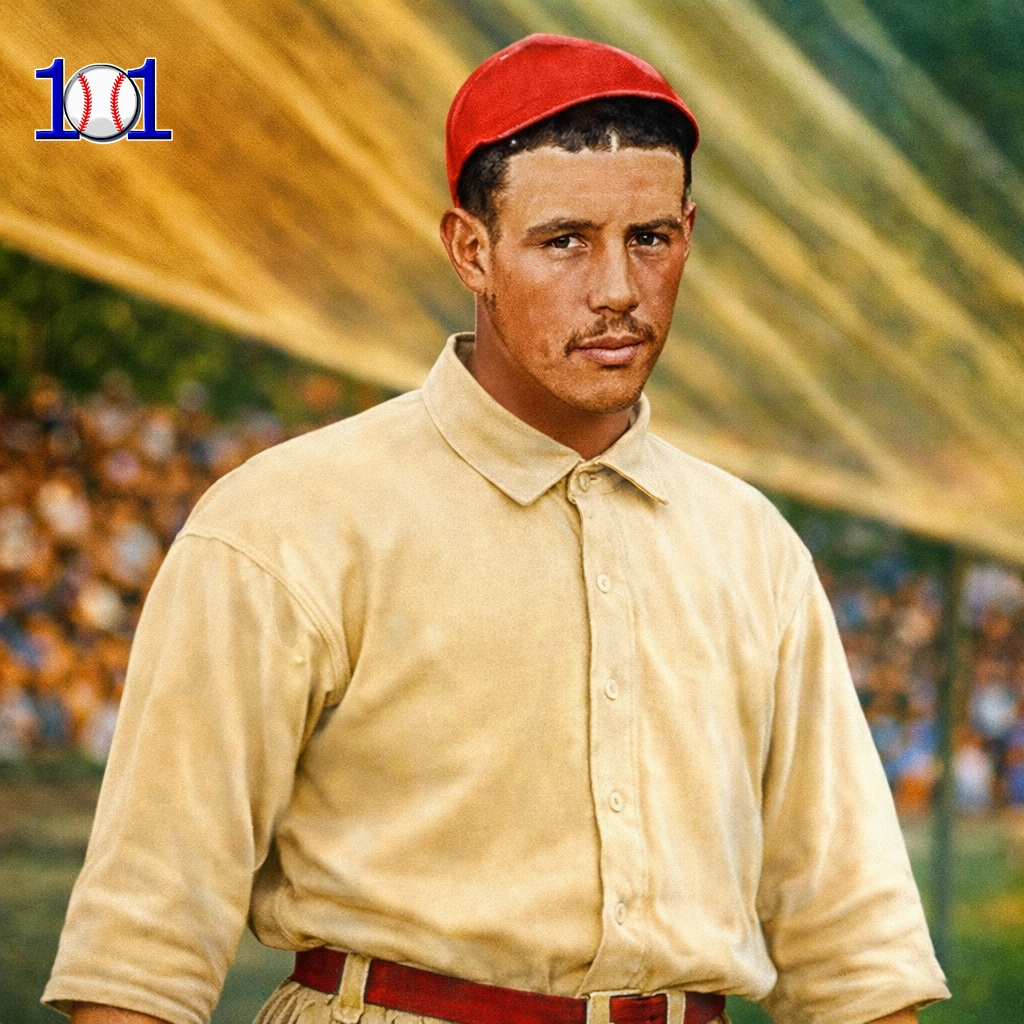
In early 1896, while Puerto Rico was still under Spanish colonial rule, a quiet movement began—one that would ignite one of the most enduring cultural expressions of the Puerto Rican people: baseball. This pioneering effort was neither accidental nor the result of spontaneous collective action. It arose from the vision and determination of a young man named Amos Iglesias Van Pelt.
Born in Brooklyn on July 12, 1879, to a Puerto Rican father, Emilio Iglesias, and a New York–born mother, Amalie Van Pelt, Amos arrived in Puerto Rico in 1895. Of mixed heritage and shaped by two worlds, he possessed the leadership, discipline, and passion that would lay the foundation for a sport destined to become a pillar of Puerto Rican identity.
While walking through Puerta de Tierra at Stop 3 in San Juan, in an area known as La Granja, Iglesias witnessed a scene that would alter the island’s sporting history: a man holding a bat and a ball. That man was Braulio Sánchez, a Cuban who explained that he had played baseball in Cuba—and that others on the island were already familiar with the game. Among them were two brothers with the surname León, nephews of then–Captain General Cabán, and a player known as Caballero.
Like Iglesias, these early players practiced baseball informally, a sport they had learned through American influence. What distinguished Iglesias, however, was not mere familiarity with the game but his vision to move beyond casual play toward the organization, instruction, and institutional growth of baseball in Puerto Rico.
Sensing the possibility of something greater, Iglesias expressed his interest in meeting them—not merely to play, but to organize. That moment marked the beginning.
A friendship soon developed between Braulio Sánchez and Amos Iglesias. Working together, they organized two teams. Sánchez gathered the Cuban players and named his team Almendares. At the same time, Iglesias dedicated himself to teaching the game to young Puerto Ricans, aided by three compatriots who shared his vision: Dr. Manuel del Valle, Engineer Manuel Saldaña, and Jesús Cabañas, who had lived in Cuba and was well acquainted with the sport.
From those efforts emerged the Borinquen Baseball Club—the first team composed entirely of Puerto Rican players. Organized and instructed by Iglesias, Borinquen represented a deliberate and structured approach to the game, emphasizing rules, positions, regular practice, and discipline. Its earliest practices took place on the grounds where the Carnegie Library would later stand.
Early Members of the Borinquen Baseball Club (1896–1898)
Amos Iglesias (P), Jesús Cabañas (C), Ignacio Carballeira (CF), Jorge C. Colombani (LF), Manuel del Valle (LF), Rafael González (1B), Eduardo Saldaña (3B), Armando Morales (2B), Enrique Gatell (3B), Luis J. Colombani (RF), José Deupí (RF), Félix Montañez (CF), D. Géigel (SS).
Reserves: Francisco Gatell, Antonio Cabañas, Severo González, and José de Jesús Tizol.
With both teams established, Iglesias coordinated with Francisco de Álamo Jiménez, president of the Santurce Velodrome—located at Stop 15—to adapt the bicycle track into a baseball field. The first diamond was laid out there by David Noble and Tito Escalona, marking the beginning of formally structured baseball on the island.
The first officially scheduled games were set for January 9, 1898, between Almendares and Borinquen. Rain suspended the contest in the third inning. A second attempt, on January 16, met the same fate, again halted by weather, with Borinquen leading 3–0.
Finally, on January 30, 1898, Borinquen defeated Almendares 9–3 in nine innings—the first complete and officially recorded baseball game in Puerto Rican history.
Games followed nearly every weekend, steadily building enthusiasm and structure. That momentum, however, was abruptly interrupted. The explosion of the battleship Maine in Havana Harbor triggered the Spanish–American War, bringing the early development of baseball on the island to a sudden halt.
Iglesias later recalled that as relations between Spain and the United States collapsed, baseball—perceived as an American game—became a source of suspicion. Fearing reprisals from Spanish authorities, the players chose to discontinue play at the velodrome. With the arrival of war, baseball activity in Puerto Rico came to a complete stop.
In later years, Iglesias was interviewed numerous times by Puerto Rican newspapers and magazines, where he recounted in detail the earliest chapters of the game on the island. His contributions would eventually receive formal recognition. On February 7, 1958, he was inducted into the inaugural class of the Puerto Rico Sports Hall of Fame. The following day, he was invited to throw the ceremonial first pitch at the Caribbean Series, held at Sixto Escobar Stadium. Decades later, in 2025, his foundational role in Puerto Rican baseball was further affirmed with his induction into the Puerto Rico Professional Baseball Hall of Fame.
These events mark the formal birth of organized baseball in Puerto Rico. Between 1896 and 1898, through vision, leadership, and organizational discipline, Amos Iglesias Van Pelt transformed an informal pastime into a structured sport—one that would endure for generations and become a defining element of Puerto Rican identity.
References:
La Verdadera HIstoria de los Deportes Puertorriqueños 1493 a 1904 por Jaime Varas.
De la pluma al papel, Dr. Emilio J. Pasarell.
Revista Boricua
Periódicos El Mundo y El Imparcial
