
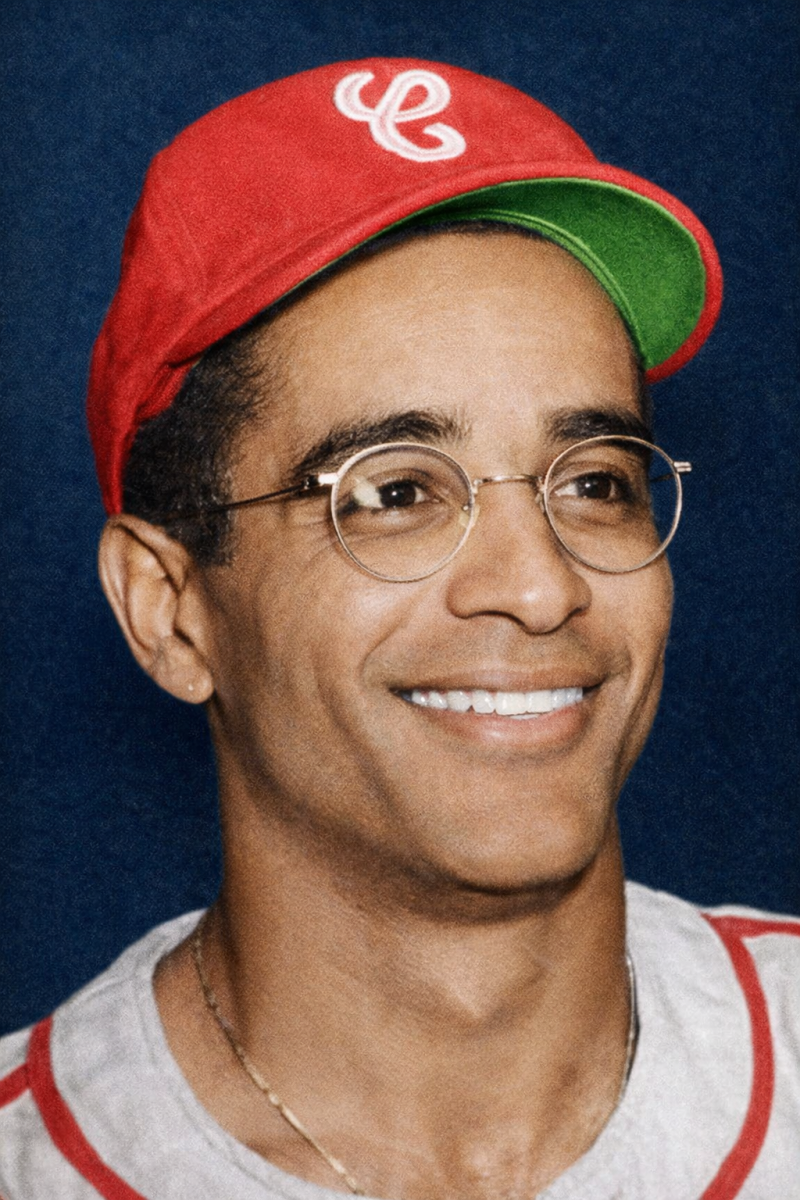
Roberto Enrique Vargas Vélez was born on May 29, 1929, in Santurce, Puerto Rico to Fernando Vargas and Carmen Velez.[1] Sadly, he was orphaned by age five and was raised by an uncle. He moved to Humacao, on Puerto Rico’s eastern coast, at 15 and studied at the local high school.
The move proved to be pivotal: “As a child I had played baseball, like any other kid in the sandlots, but also basketball and volleyball. I didn’t have a predilection for baseball. With Humacao I began practicing with the team.”[2]
Curiously, Vargas didn’t follow the Puerto Rican Winter League (PRWL). While in high school, the svelte 5-foot-11, 175-pound lefthander was recruited to play for a local youth team as a pitcher. He soon progressed to the semi-professional Double-A level with Juncos, managed by the legendary Pedro “Perucho” Cepeda, and led the team to its first title thanks to his 98 strikeouts and 2.01 ERA.[3] Selected to the Puerto Rican team, he was named the best left-handed pitcher in an amateur tournament in Colombia, where his 4-1 record and 38 strikeouts earned him the nickname “the Premier.”[4] The Puerto Rican team also featured future major-leaguers Saturnino “Nino” Escalera and Valmy Thomas.
While baseball was fun, Vargas had not yet considered it as a career, partly due to a lack of proper instruction: “It wasn’t until I played professionally that I had proper coaching. Cepeda was a hitter, so he didn’t give us pitchers much guidance. After the games, they would pass the hat and the fans would contribute.”[5] His uncle initially opposed the idea of playing professionally but later acquiesced.
Vargas signed with the Caguas Criollos rather than his hometown Santurce Cangrejeros, given the former’s track record of developing pitcher and Héctor Solavo’s recommendation of an $800 bonus. The team quickly noticed a weakness: “Once I reached Caguas, they realized I couldn’t see well so they sent me to an optometrist who prescribed glasses.”[6] They would become a hallmark of his career, and rare is a Vargas photograph without his eyeglasses. Caguas co-owner Pepe Seda also gave Vargas critical advice: “Seda taught me to hide my tell. When I was about to throw a curve, one of my fingers stood out. He told me everyone knew what was coming, so I began bending that finger.”[7]
The franchise nurtured its young player, who had returned from Colombia with a hurt shoulder. He was mostly a reliever in his first season, and struggled in 13 games (5.64 ERA, 29 walks and 29 strikeouts). In his remarkable October 26 debut, he pitched eight innings and allowed two runs against Santurce. His opponent, fellow rookie Rubén Gómez, pitched 11 innings and lost a hard-fought, 3-2 decision.[8]
Patience proved to be a virtue for the still-developing Vargas: “I had a lively fastball-it it wasn’t the fastest one, but it had moved a lot. I also had a good curveball but I didn’t learn a changeup until seven or eight years into my professional career. Back then we played only three games a week (two on Saturday and one on Sunday) so we didn’t carry too many pitchers. Typically, the American pitchers would get two and a native would take the other, so there were not many opportunities, especially for a rookie.”[9] Caguas, led by Juan “Tetelo” Vargas (no relation), Lorenzo “Piper” Davis, Chester Brewer, and Rafaelito Ortiz, defeated Mayagüez, 4-3, in a riveting seven-game final series.
Despite the limited playing time, Caguas catcher/manager Quincy Trouppe noticed Vargas’s raw potential. After three years piloting the Cleveland Buckeyes (including the team’s 1945 title), he was recruited to manage the Chicago American Giants. Trouppe brought the 19-year Vargas, the 21-year old Bienvenido Rodríguez, and 33-year old Ortiz to the mainland. Alphonso “Piggy” Gerard, a St. Croix, USVI native who played with Santurce, joined the squad.
Vargas recognized the opportunity and the challenge: “Road trips were awful; we’d ride on these buses for a long time. Back then, racism was entrenched. Blacks had no equality with whites, they were all separate. There was heavy resentment. Rodríguez, Ortiz, Gerard, and I would hang out. I was barely out of school, so I knew some English. I quickly picked up more by hanging out with the American players and speaking English with them. The sheer size of the country and the cold took some adjustment. It was still cold during spring training, but I didn’t miss Puerto Rico. I just focused on baseball.”[10] Nevertheless, it was a stark contrast from the island, where players of all races mixed freely.
Although Negro League statistics are incomplete, Seamheads credits Vargas with three games, one loss, and a 4.96 ERA in 16 1/3 innings.[11] James A. Riley notes the “light-complected Puerto Rican but was considered black” was 6-8 with a 3.09 ERA.[12] While the 26-52 American Giants finished last in the Negro American League, Trouppe, Gentry Jessup, and Vargas were selected to play in the East-West All Star Game.[13] He allowed two hits and one walk in 1 2/3 innings but did not allow a run.[14]
After his year with the American Giants, Vargas played for the Drummondville Cubs of the Provincial League in 1949 and Jalisco of the Mexican League in 1950. Competition in these independent circuits was mixed: “by the time I played in the Mexican League, there were few big leaguers. There were many good Cuban players, but the Americans were not of major-league caliber, likely because it was a year-round league. In Canada we had Trouppe, Pellot, Danny Gardella…and there was no racism in Canada. In Drumondville, a small town where French is mostly spoken, we mostly rode bikes.”[15]
Although his workload increased from playing year-round, “I just loved to play baseball. I never worried about hurting my arm. What affected me the most in the big leagues was in Puerto Rico we only played weekends and we practiced twice a week. We didn’t worry about playing in optimal condition.”[16]
Vargas played for Lakeland of the Florida International League in 1951, mostly as a starter, and won a career-high 18 games with a 2.69 ERA, including a one-hitter on June 13.[17] The Cleveland Indians signed him to a minor league contract and he played with Reading of the Class-A Eastern League in 1952 (13-10, 2.75, with a 24 scoreless inning streak)[18]. He was less effective in 1954 (12-13, 4.80) but tossed another one-hitter.[19] While not confirmed, he is believed to have played in the Dominican Republic in 1953.
The Milwaukee Braves drafted Vargas in late 1954 with high hopes. An offseason Sporting News article deemed him a “can’t miss” prospect; scout Dewey Griggs “was confident Vargas is ready.”[20] El Imparcial frothed about “another Puerto Rican pitcher in the majors,” noting Vargas “has several effective pitches that can readily disarm many good hitters…he does not waste effort in any superfluous warmup pitches and at first glance, anyone would think he lacks velocity.”[21] By January 1955, an in-depth article on prospects from the Caribbean leagues noted that “Clemente, Pirate Property, and Vargas, Claimed by Braves, (Are) Highly Praised.”[22]
Vargas debuted on April 17 against the Cincinnati Redlegs. Starter Charles Gorin was lifted after he gave up three runs in the bottom of the fourth inning. With two outs and a runner on first, Vargas retired Gus Bell on a pop fly behind first base. He pitched a scoreless fifth before George Crowe pinch-hit for him in the top of the sixth inning. While Milwaukee contended, “the Dodgers won 19 straight to start the season and we were supposed to be strong contenders…but with the Dodgers fast start, manager Charlie Greene only played the veterans, so young ones like us would rarely play. I might pitch against a lefthander batter and then get taken out…I didn’t like it since I was used to the skipper having confidence in me.”[23]
Vargas recalled an August 27 game “in New York against the Giants. We’re up by a run in the ninth with bases loaded, their cleanup hitter, I’m brought in, and I get the guy to pop up to the catcher. Two outs. Gómez, a righty, is announced as the pinch-hitter. Greene removes me despite knowing the Giants had a few good lefties on the bench. We’d been better off keeping me against Gómez rather than removing me and then having a righty against the bench lefties. Rubén was a good hitting pitcher, but it was a chess move to take me out of the game.”[24] While Vargas misremembered a few facts (it was the bottom of the 11th inning, he retired Dusty Rhodes, who pinch hit for pitcher Marv Grissom, and Gómez then pinch hit for leadoff hitter Billy Gardner), the scenario played out as he expected. Vargas was lifted for Ernie Johnson, but Bill Taylor pinch-hit for Gómez to negate the platoon advantage.[25] Nevertheless, Johnson retired Taylor to preserve the Braves’ victory.
Vargas recalled Greene was unwilling to discipline the team: “one time in New York, I was dropped off by family at the hotel around 2 AM and sat down in the lobby to read the newspaper. Between 3AM and 4AM I saw many of my drunken teammates stagger in, but there were no repercussions.”[26]
Although Milwaukee finished 13 ½ games behind Brooklyn and Vargas struggled as a middle reliever (26 games, 8.76 ERA, 2.149 WHIP, two saves), he cherished the experience: “The major leagues are the major leagues…the clubhouse, the parks, the hotels, first class all around. There were many Puerto Ricans in Milwaukee, it was a nice community, and my wife and I were invited to social gatherings.”[27]
Milwaukee reassigned him to the American Association’s Wichita Braves in 1956. In 40 games, he lowered his ERA to 6.20 and won six games, including a shutout. He was acquired by the Dodgers, with whom he played three seasons across their Triple-A, Double-A, and Class-A affiliates, a stretch he enjoyed: “I felt at ease, playing more often, felt wanted by the team.”[28]
Vargas played with Poza Rica of the Mexican League from 1959-1961, mostly as a starter. Although he was named the league’s best left handed pitcher in 1959, “toward the end I hurt my arm. I returned to Puerto Rico and played injured, had a bad season. I returned to Mexico and declined an offer to the United States because I was injured and returned to Puerto Rico. We had a trainer but not a team doctor…Mexico was known as the grave of baseball players.”[29]
Vargas played 15 consecutive seasons in the PRWL, all but one with Caguas, whose new ownership he resented: “I signed with Arecibo…I couldn’t help them much, they asked me to return as a coach the next year…but by then I realized baseball was not a game but work. I always thought Caguas should have offered me the coaching job since I gave them my best years.”[30]
As of the 2025-26 PRWL season, he is seventh in career strikeouts (630) and innings (1329). His 84 victories rank ninth all-time, and he enjoyed four years of 10+ wins. He and Luis Febres combined to no-hit Aguadilla on December 31, 1950.
His Caguas teams won five championships (1947-48, 1949-50, 1953-54, 1957-58, and 1959-60). He appeared in six Caribbean Series, where he pitched 44 2/3 innings and went 2-1.[31] Among his favorite teammates was Víctor Pellot (aka Vic Power in the United States): “Pellot was my teammate for 13 years. We were always good friends… I’ve never seen anyone play first base like him. He was also super smart, not just the skill. He pioneered the one-hand catch when everyone was taught to use both.”[32]
Vargas had a front-row seat to Henry Aaron’s development: “When he came to Puerto Rico he was a second baseman but he wasn’t working out, you could he see he was awkward. Mickey Owen told him, ‘if you have men on scoring position and you take a strike, I will fine you’ so he would be more aggressive at the plate.”[33]
Two opponents awed him: “Willie Mays hit everyone, he hit almost .400 (that year). I recall a home run he hit off me at Sixto Escobar.”[34] When asked about the most complete Puerto Rican player, he remarked “Perucho Cepeda would’ve been a regular in the majors. Francisco “Pancho” Coimbre was the best Puerto Rican hitter according to Satchel (Paige) but no one was as complete as Clemente. He hit his first PRWL hit against me. We were playing in Caguas and he pitch hit for Bob Thurman whom I could easily retire…with a man on second, Clemente hit a double between right and center field. I think it was his first plate appearance.”[35] Clemente himself recalled “I honestly didn’t think I was called up to bat, but rather to pinch run for Willard Brown. Once I reached the plated I asked God to help me, and he did!”[36]
Vargas was a key figure in the 1950-51 final series between Caguas and Santurce. He lost the second game, a 15-8 slugfest, against Gómez on February 11. Two days later, he evened the series with a 6-4 victory. As the clubs battled in the final game, Luis Raúl “El Tigre” Cabrera and Vargas allowed two runs apiece through seven innings. Caguas manager Luis Rodríguez Olmo lifted Vargas for his closer, Mike Clark, who gave up a towering home run to José Saint Claire (Pepe Lucas) in the ninth for the walk-off victory.[37] The home run remains the PRWL’s most memorable moment, forever known as the “pepelucaso” (the Pepe Lucas Blast).[38]
Vargas was elected to the Caribbean Series Hall of Fame in 2020 and was recognized as one of the PRWL’s 75 best players in 2013. He died in Caguas on May 27, 2014, two days shy of his 85th birthday. He is buried in the city’s Cementerio Borinquen Memorial Park.
Acknowledgments
Frank Otto, for his interview with Roberto Vargas on August 8, 1992. The four-part interview is part of the SABR Oral History Collection.
Notes
The author relied on Beisbol101.com, Baseballreference.com, Seamheads.com, and Retrosheet.org
[1] «Puerto Rico, Registro Civil, 1805-2002», FamilySearch (https://www.familysearch.org/ark:/61903/1:1:QVJM-4V4J : Wed May 14 07:19:08 UTC 2025), Entry for Roberto Enríque Vargas y Velez and Fernando Vargas, 1929.
[2] Frank Otto, “Roberto Vargas,” SABR Oral History, August 8, 1992, https://sabr.org/interview/roberto-vargas-1992/
[3] Jorge Colón Delgado, “Roberto Vargas: grande entre los grandes,” Béisbol 101, May 29, 2014, https://beisbol101.com/roberto-vargas-grande-entre-los-grandes/
[4] Colón Delgado, “Roberto Vargas: grande entre los grandes.”
[5] Otto interview.
[6] Otto interview.
[7] Otto interview.
[8] Tommy Blake, “Caguas derrota a Santurce en 11 entradas,” El Imparcial, October 27, 1947: 34, https://gpa.eastview.com/eida/newspapers/eida19471027-01.1.35
[9] Otto interview.
[10] Otto interview.
[11] “Roberto Vargas,” Seamheads.
[12] James A. Riley, “The Biographical Encyclopedia of the Negro Baseball Leagues,” Carroll & Graf Publishers, New York,1994: 801.
[13] The team’s NAL record was 26-52. Their overall record, including non-league games, was 38-60-2 (Seamheads).
[14] “Roberto Vargas,” Seamheads, https://www.seamheads.com/NegroLgs/player.php?playerID=varga01rob
[15] Otto interview.
[16] Otto interview.
[17] “Israel hits for the cycle again,” Sporting News, June 27, 1951: 36.
[18] “Eastern League: Radcliffe wins first half,” Sporting News, August 13, 1952: 33.
[19] “Vargas’ One-Hitter Defeats Penson, Who Gives Up Two,” Sporting News, June 23, 1954: 35.
[20] Red Thisted, “Braves Have More on Way” Sporting News, December 15, 1954: 22.
[21] “Otro lanzador boricua en las mayores,” El Imparcial, December 12, 1954: 40, https://gpa.eastview.com/eida/newspapers/eida19541212-01.1.39
[22] Clifford Kachline, “Winter Leagues Boast Fine Crop of Prospects,” Sporting News, January 12, 1955: 21.
[23] Otto interview.
[24] Otto interview.
[25] Milwaukee Braves 4, New York Giants 5, August 27, 1955 Box Score, Baseball Reference, https://www.baseball-reference.com/boxes/NY1/NY1195508270.shtml
[26] Otto interview.
[27] Otto interview.
[28] Otto interview.
[29] Otto interview.
[30] Otto interview.
[31] Colón Delgado, “Roberto Vargas: grande entre los grandes.”
[32] Otto interview.
[33] Otto interview.
[34] Otto interview.
[35] Otto interview.
[36] Luisín Rosario, “Todo Ganan y Todos Pierden,” El Imparcial, June 14, 1972: 3-B, 4-B, (27-28), https://gpa.eastview.com/eida/newspapers/eida19720614-01.1.28
[37] “El jonrón más famoso de la historia de Santurce,” Cangrejeros de Santurce Facebook page, July 2, 2024, https://www.facebook.com/watch/?v=1047470060332132
[38] Cuqui Córdova, “El Pepelucaso,” Diario, January 6, 2015, https://listindiario.com/el-deporte/2015/01/06/351504/el-pepelucaso.html
