
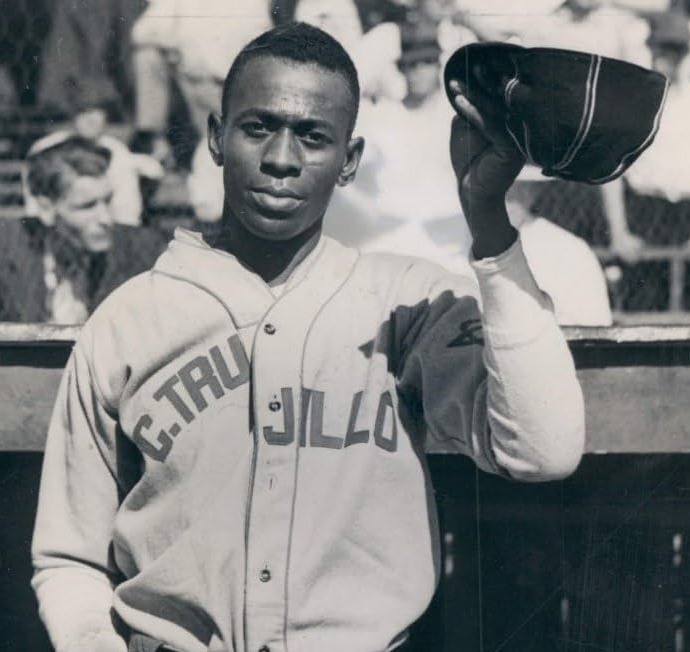
July 11, 1937: Águilas Dragones de Ciudad Trujillo 8, Cibaeñas de Santiago 6, at Campo Deportivo Municipal, Ciudad Trujillo (Santo Domingo), Dominican Republic
A baseball box score is an enthralling treasure trove. Readers can reconstruct the game and capture, like debits and credits in accounting, each player’s performance. But much like logos needs pathos, even the most detailed box score requires a compelling game story to capture the emotion.
The July 12, 1937, Listín Diario headline was succinct: “In sensational fashion, the ‘Ciudad Trujillo B.B.C.’ won 1937-38 the National Base Ball Championship, ‘for the Re-Election of President Trujillo.”[1] The last phrase was not hyperbole but rather blatant propaganda from the dictatorship’s muzzled press.
The Ciudad Trujillo (formerly Santo Domingo, the capital, re-named after the vain leader), Dragones (Dragons), and the Águilas Cibaeñas (Eagles) of Santiago were all but destined to meet in a final, winner-takes-all game. Dr. Enrique Aybar had combined the Tigres (Tigers) of Licey and the Leones (Lions) of Escogido to form a super club. To bolster the team, Aybar recruited Satchel Paige and raided the Pittsburgh Crawfords roster.
The Dragones had three all-time Negro League greats: Cool Papa Bell, Josh Gibson, and Paige. But Santiago’s Martín Dihigo was a true virtuoso whose prowess in all nine positions was matched by his acumen as the team’s manager.
The Americans enjoyed their summer. Weekend games – rather than the daily grind – and the lack of overt racism provided a welcome respite from the hostile environment of the United States. The party, however, would end suddenly if the Dragones did not win the championship. It would not be a mere loss on the field but a stain on Rafael Trujillo’s honor, one bound to be punishable by the regime’s wanton disregard for human rights. The possibility was firmly on their mind as the clubs met in the Campo Deportivo Municipal, a less-than-neutral site given the government presence.
Santiago’s Chet Brewer and Ciudad Trujillo’s Leroy Matlock traded zeroes through the first four innings. Brewer, fresh off a commanding two-hitter against the Dragones the prior Sunday, wobbled in the first but escaped harm after Bell was caught stealing third base. The hosts managed a scant three hits off Brewer, scattered among the first dozen outs.
In the fifth, Matlock allowed a leadoff single to David Thomas but retired the side to keep the Aguilas off the scoreboard. Brewer was not as lucky and unraveled in the bottom half. Cuco Correa walked, and Matlock bunted. The ball bounced meekly to the mound, raising Brewer’s hopes of a double play. His throw to second was high, and both runners were safe. Leadoff hitter Bell, with two strikes on the count, beat out shortstop Horacio Martínez’s throw to first.
With the bases loaded, Harry Williams singled to center, scoring Correa and Matlock while Bell advanced to third. Player/manager Lázaro Salazar also singled, and Bell raced home for the third run. The mighty Gibson, whose .453 average led the league, strode to the plate and hit an infield single, again leaving Brewer with no room for error.
Center fielder Dihigo, sensing the critical juncture, called for time and took the mound. The veteran tried to slow down the pace by taking leisurely warm-up tosses before Sammy Bankhead walloped a grand slam that landed on Calle Piña, behind the oceanside stadium. Dihigo retired Cy Perkins and Tony Castaño before Correa beat out an infield hit and reached second on a throwing error. Matlock doubled for the eighth and final run before Williams struck out to end the frame. Dragones 8, Águilas Cibaeñas 0.
An eight-run lead seemed insurmountable. While Santiago scored a pair in the sixth inning, it squandered an opportunity in the seventh by hitting into a double play. The Aguilas Cibaeñas entered the ninth inning with its title hopes in dire straits. As Dihigo implored his batters to make contact, Thomas singled and took second on Bell’s bobble. Bragaña García’s single drove in Thomas but Brewer retired Belito Alvarez for the first out. Spearman’s single to left field moved García into scoring position. Pat Patterson was announced as the pinch-hitter, replacing Horacio.
With the game now 8-3, Sálazar summoned Paige to the mound. In his 1948 autobiography Pitchin’ Man, Paige remarked the heavily armed soldiers along foul territory. Despite his usual bravado, he felt the pressure: “L-l-l-listen S-s-s-atch, pull yourself together before they air-condition you.”[2]
Patterson singled to drive in Bragaña. Spearman took third and scored on a Santos Amaro single. Two men remained on the bases, but Roy “Red” Parnell grounded into a force play at second to retire Amaro from the basepaths. With one out to go, Paige had an 8-5 lead. The two inherited runners were charged to Matlock, whose final line showed 12 hits, four strikeouts, two walks, and five runs allowed in 8 1/3 innings.
The perennially dangerous Dihigo entered the batter’s box. The Cuban star and Paige were well-acquainted; besides four games earlier that summer, they had battled in the 1929-1930 Cuban Winter League. Fans delighted in the duel, knowing Dihigo could tie the game with one swing. Paige could walk him but that would bring the go-ahead run to the plate. The crowd roared as Paige entered his windup and hurled a fastball to the plate.
Dihigo’s single, his fourth safety of the afternoon, scored Patterson and moved Parnell to third. In mere minutes, a comfortable lead turned into an asphyxiatingly close margin. Clarence “Spoony” Palm could now the play the hero. Fans, players, and even soldiers held their breath as Palm’s grounder to deep short found its way to Bankhead’s glove. An off-balance throw to first appeared beyond Salazar’s reach, but the player-manager stretched just enough to record the final out.
The Dragones, champions. Paige, pitching in relief, relieved to escape to tell the tale. Trujillo, the true winner. The despot would rule for another two decades before his assassination on May 30, 1961.
Paige would later embellish his performance, shaving two runs from his club’s total: “All we could hear from them fans was warnings about we better win. The more they yelled the harder I threw and I bet I never had a better fast ball only I never see (sic) any better hitters than them guys. But in the seventh inning we score two runs and then I manage to shut them out the last two frames and we win, 6 to 5.”[3]
“Satchel, old boy, ‘I say to myself, if you’ve ever pitched, it’s now,’” he reminisced in My Greatest Day in Baseball.[4] Four years after Trujillo’s death, Paige confided to Wendell Smith that “The people came down to the dock by the thousands to cheer us and give us big bouquets of flowers. I often thought afterward that those flowers could have been on my grave if we hadn’t won that game.”[5]
Paige’s pitching line was unimpressive. In 2/3 of an inning, he allowed three inherited runners to score and permitted a run of his own. He did not strike out a batter and gave up three singles. It may not have been pretty, but it was sufficient to live another day.
Beisbol101 is included in the Digital Library of Latin American and Caribbean Sports (DLLACS).
Notes
[1] Ty Cobb (pseudonym), “El ‘Ciudad Trujillo B.B.C’ ganó sensacionalmente el Campeonato Nacional de Base Ball 1937-38, ‘Pro-Reelección Presidente Trujillo,” Listín Diario, July 12, 1937: 6.
[2] Satchel Paige and Hal Lebovitz, “Pichin’ Man,” 1948, Gray & Co Publishers, Chapter 14, page 59, https://www.google.com/books/edition/Pitchin_Man/5aV15PLwJBAC?hl=en&gbpv=1&bsq=condition
[3] Sam Gazdziak, “Satchel Paige Pitches for His Life,” RIP Baseball, May 25, 2020, https://ripbaseball.com/2020/05/25/satchel-paige-pitches-for-his-life/
[4] John Carmichael, My Greatest Day in Baseball (Omaha: University of Nebraska Press, 1996), 151-152.
[5] Wendell Smith, “Wendell Smith’s Sports Beat,” Pittsburgh Courier, July 24, 1965: 23.

Le fue más sensato jugar para Guayama que para Trujillo.